Geotechnicalengineering1
MELBOURNE
HomeSlopes & WallsSlope Stability Analysis

Slope Stability Analysis in Melbourne — Geotechnical Assessment for Safe Excavations

Technical studies that support your project.

LEARN MORE

Melbourne sits on a mix of Quaternary basalts, Silurian mudstones and Quaternary alluvium, so slope behaviour varies block by block. In our lab, we apply AS 4678-2002 (Earth Retaining Structures) and AS 1726-2017 (Geotechnical Site Investigations) as the baseline for every stability assessment. For a deep cut in the Yarra Valley clays, for instance, we first run a resistivity survey to map subsurface layering — that data feeds directly into our limit-equilibrium models. The same approach applies to the steep coastal bluffs around the Mornington Peninsula, where we combine field mapping with laboratory shear-strength testing to define realistic failure surfaces. Every Melbourne project gets a city-specific factor of safety, never a generic default.
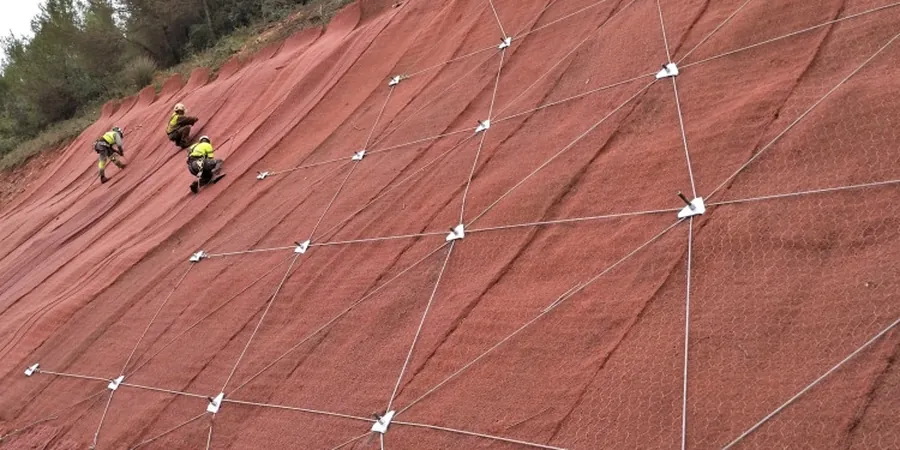
Illustrative image of Slope stability analysis in Melbourne
In Melbourne, the clay crust can lose 40% of its undrained strength when saturated — seasonal moisture is the real trigger for slope failure.
Our service areas

Methodology and scope

What we see most in Melbourne is that the local clay crust — the upper 2-3 metres of basaltic clay — can lose 40% of its undrained strength when wet. That seasonal change matters. Our analysis workflow includes:
  • Limit-equilibrium methods (Bishop simplified, Morgenstern-Price) for circular and non-circular slip surfaces
  • Direct shear and triaxial testing on undisturbed samples from the critical depth zone
  • Groundwater modelling using piezometer data from wet-winter conditions
We also check for existing tension cracks and old fill boundaries. If the site has a history of landslip, we incorporate a drainage geotechnical design to control pore pressure build-up. For road cuttings on the eastern suburbs, we often cross-check results with a falla de taludes back-analysis to calibrate the model to local failure scars. The whole process is documented under NATA-accredited quality systems.
Technical reference — Melbourne

Local considerations

Melbourne recorded its wettest 12-month period in 2022, with over 900 mm of rain in some suburbs. That kind of saturation saturates the basaltic clay mantle, reduces effective stress, and can trigger shallow translational slides on slopes steeper than 1:3. In the Dandenong Ranges, where residential lots are carved into hillsides, we have seen retaining walls bulge after consecutive wet winters because the drainage layer was undersized. A slope stability analysis that accounts for Melbourne's real rainfall recharge — not a textbook assumption — is the difference between a functioning cut and a costly repair. The city's seismic hazard is low (AS 1170.4), but even minor ground shaking on a saturated slope can push the factor of safety below 1.0.

Need a geotechnical assessment?

Reply within 24h.

Email: contact@geotechnicalengineering1.vip

Applicable standards

AS 4678-2002 — Earth Retaining Structures, AS 1726-2017 — Geotechnical Site Investigations, AS/NZS 1170.4:2002 — Structural Design Actions (Earthquake)

Technical parameters

ParameterTypical value
Factor of safety target1.3 (temporary) – 1.5 (permanent) per AS 4678
Shear strength methodDirect shear (AS 1289.6.2.2) or CU triaxial (AS 1289.6.4.2)
Groundwater conditionWorst-case winter phreatic surface from standpipes
Slip surface typeCircular (Bishop) and non-circular (Morgenstern-Price)
Soil unit weightMeasured on undisturbed tube samples (AS 1289)

Frequently asked questions

What factor of safety do Melbourne councils typically require for slope stability?

Most Melbourne councils require a minimum factor of safety of 1.5 for permanent slopes under drained conditions, and 1.3 for temporary cuts (less than 12 months). Some municipalities, like the Yarra Ranges, may ask for 1.6 if the slope is steeper than 1:2 or has a history of instability. We always confirm the specific requirement with the relevant council early in the project.

How do you account for seasonal moisture changes in a Melbourne slope analysis?

We model two groundwater scenarios: a dry-summer case based on measured piezometer data, and a wet-winter case using the highest recorded seasonal water table plus a 0.5 m surcharge for extreme rainfall events. The analysis uses the winter case to calculate the design factor of safety, because that is when Melbourne's basaltic clays are weakest.

What is the typical cost range for a slope stability analysis in Melbourne?

A standard slope stability analysis for a single residential cut in Melbourne typically ranges between AU$1,700 and AU$3,400. For larger projects — embankments over 4 m high or multiple cross-sections — the cost can go up to AU$6,210. The variation depends on the number of sections, the need for undisturbed sampling, and the complexity of the groundwater regime.

Location and service area

We serve projects across Melbourne.

Location and service area