Geotechnicalengineering1
MELBOURNE
HomeIn-Situ TestingEnsayo Presiómetro de Ménard

Ménard Pressuremeter Test (PMT) in Melbourne – In-Situ Soil Stiffness & Strength

Technical studies that support your project.

LEARN MORE

Melbourne's geology is deceptive. Under the basalt flows of the west lie stiff clays; east of the Yarra, deep silty sands dominate. The Ménard pressuremeter test (PMT) captures the actual stress-strain response of these layers without disturbing the ground. It gives us the Menard modulus (EM) and limit pressure (pL) directly. This data is critical for raft foundation design on the Coode Island silt or pile design in the Brighton sands. We run each test to AS 1726 standards, using a pre-calibrated probe and real-time volume readings. The result is a reliable deformation modulus, not an empirical correlation. For projects where settlement tolerance is tight, the PMT is the most defensible in-situ tool available.
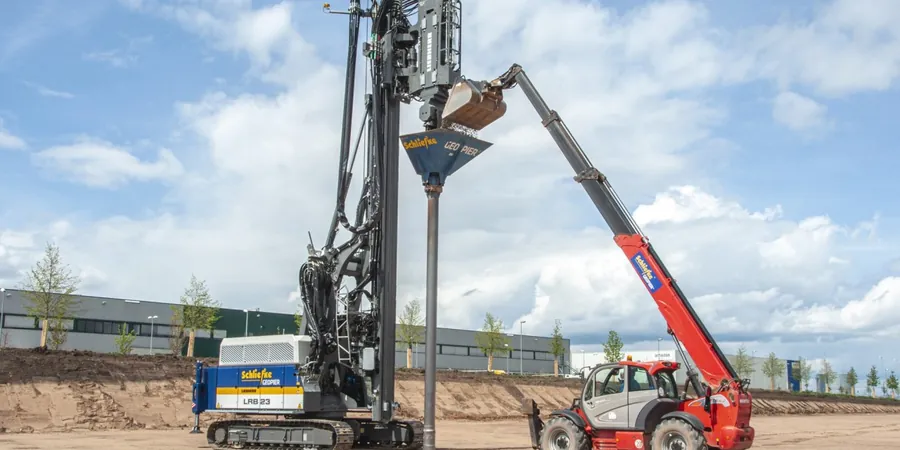
Illustrative image of Ménard pressuremeter test (PMT) in Melbourne
Unlike SPT or CPT, the PMT measures soil stiffness at the exact pressure range the foundation will experience. This makes it the most accurate in-situ test for settlement prediction in Melbourne's variable clays and sands.

Our service areas

Methodology and scope

The difference between the stiff basalt-derived clays in Footscray and the soft alluvial silts in Southbank is enormous. A standard SPT blow count won't tell you the full story. The PMT measures two independent parameters: the Menard modulus (EM) and the limit pressure (pL). From these we derive the rheological coefficient (α) and the net limit pressure. This allows us to calculate settlement accurately for shallow footings or to design piles with friction and end-bearing components where lateral variability is high. The test sequence follows the AS 1289 procedure: drilling a clean borehole, expanding the probe in 30-second load increments, and recording the volume-pressure curve. Key parameters we report include:
  • Menard modulus (EM) in MPa
  • Limit pressure (pL) in MPa
  • Rheological coefficient (α)
  • Net limit pressure (pL*)
  • Pressuremeter creep pressure (pf)
These values feed directly into settlement calculations under AS 4678 for retaining walls or AS/NZS 1170 for general foundations.
Technical reference — Melbourne

Local considerations

Melbourne's Coode Island silt is notorious. It's a soft, compressible clay with high plasticity and low undrained shear strength. A PMT run in this layer gives you the modulus at working stress levels, not the unload-reload modulus from a lab test. Ignore the difference and your raft foundation could settle 50 mm more than predicted. The western suburbs have basalt-derived clays that appear stiff but contain relict joints. The PMT detects these weak zones by showing a lower limit pressure than the modulus suggests. Without this data, you risk differential settlement between columns. The cost of one PMT borehole is trivial compared to a slab replacement in a building with 10 mm differential movement.

Need a geotechnical assessment?

Reply within 24h.

Email: contact@geotechnicalengineering1.vip

Explanatory video

Applicable standards

AS 1726 – Geotechnical site investigations (borehole preparation and test execution), AS 1289 – Standard test method for pressuremeter testing in soils, AS 4678 – Earth-retaining structures (uses PMT modulus for wall deflection analysis)

Technical parameters

ParameterTypical value
Menard modulus (EM)2.3 – 45 MPa (typical range for Melbourne clays)
Limit pressure (pL)0.5 – 3.2 MPa (varies with depth and soil type)
Rheological coefficient (α)0.33 – 0.67 (clay to sand transition)
Creep pressure (pf)0.6 – 1.8 MPa (onset of plastic deformation)
Test depth range1.0 – 30.0 m (borehole dependent)

Frequently asked questions

How deep can the Ménard pressuremeter test be performed in Melbourne?

The PMT can be run from 1.0 m down to 30.0 m depth, limited by the borehole stability and the probe cable length. In the Coode Island silt, we typically stop at 20 m due to borehole collapse risk. In the basalt-derived clays of the west, we can reach 30 m with a polymer mud.

What is the difference between the Menard modulus (EM) and the limit pressure (pL)?

The Menard modulus (EM) represents the soil stiffness in the elastic range — how much it deforms under working loads. The limit pressure (pL) is the pressure at which the soil fails plastically. For foundation design, EM controls settlement and pL controls bearing capacity. Both are needed for a complete analysis.

How much does a Ménard pressuremeter test cost in Melbourne?

A single PMT test point costs between AU$1.500 and AU$2.180, depending on depth, site access, and number of tests. A full investigation with 6 test points in a single borehole typically ranges from AU$6.500 to AU$9.500. This includes borehole drilling, probe calibration, field execution, and a data report.

Can the PMT be used for settlement prediction in Melbourne's Coode Island silt?

Yes. The PMT is the preferred in-situ test for settlement prediction in soft clays because it measures the soil modulus at the exact stress range the foundation will apply. For the Coode Island silt, we use the Menard modulus (EM) with a rheological coefficient (α) of 0.5 to calculate immediate and creep settlement. This is more reliable than using an empirical SPT correlation.

Location and service area

We serve projects across Melbourne.

Location and service area