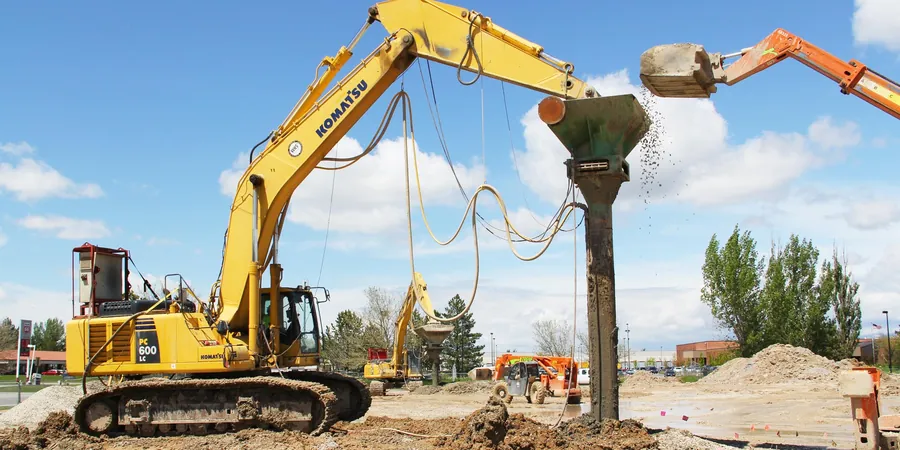
In Melbourne, the category of Ground Improvement encompasses a suite of geotechnical engineering techniques designed to permanently enhance the physical and mechanical properties of soil and fill materials. As the city expands into areas underlain by weak, compressible, or variable ground, the ability to reliably improve foundation conditions has become fundamental to safe and economical construction. This category covers methodologies that increase bearing capacity, reduce settlement, mitigate liquefaction potential, and control groundwater, transforming marginal sites into viable building platforms. From large-scale residential subdivisions in growth corridors like Wyndham and Casey to critical infrastructure in the Port of Melbourne, ground improvement is often the defining factor between project feasibility and costly over-excavation or deep foundation alternatives.
Melbourne's geological diversity is a primary driver for ground improvement. Much of the western and southeastern suburbs are blanketed by Quaternary basalts of the Newer Volcanics Province, which overlay highly compressible Coode Island Silt and Fishermans Bend Silt deposits. These soft estuarine clays, often exceeding 20 metres in thickness along the Yarra River corridor and near Port Phillip Bay, are prone to significant long-term settlement under load. Similarly, the alluvial floodplains of the Maribyrnong and Werribee rivers feature loose, saturated sands and silts that can be susceptible to cyclic mobility during seismic events. In the eastern suburbs, colluvial fills and deeply weathered Silurian mudstones present challenges of variable stiffness and reactivity. These conditions demand a tailored approach, where no single improvement method is universally applicable, and site-specific design is paramount.
Australian regulatory frameworks heavily influence ground improvement design and execution. All works must comply with the National Construction Code (NCC) and be certified against AS 2870 for residential slabs and footings, AS 2159 for piling, and AS 3798 for earthworks. For dynamic compaction and vibrocompaction, adherence to AS 5100.3 for bridge foundations or specific performance criteria set by the Victorian Department of Transport and Planning is common. Environmental controls, particularly for jet grouting spoil management and groundwater discharge, are governed by EPA Victoria's Publication 1834 and the General Environmental Duty under the Environment Protection Act 2017. Geosynthetic specifications must align with AS 3706.2 and 3706.3 for geotextiles and geogrids, ensuring durability and tensile strength requirements are met for Melbourne's sometimes aggressive soil chemistries. These standards collectively mandate rigorous site investigation, design validation, and post-treatment verification testing, such as Cone Penetration Tests (CPTu) and plate load tests, to confirm that performance criteria are achieved.
The types of projects requiring ground improvement in Melbourne are extensive. Large-scale warehouse and logistics facilities in the western suburbs frequently employ preloading with surcharge design combined with geotextile specification for drainage and separation over soft clays. Infrastructure projects, including road embankments and rail corridors like the Level Crossing Removal Project, rely on lime and cement stabilization to modify moisture-sensitive subgrades or geogrid specification for mechanically stabilised earth walls. In areas with loose granular fills, vibrocompaction design and dynamic compaction design are routinely specified to densify the ground and reduce future settlement. Where groundwater control is critical, or for creating cut-off walls in contaminated land remediation, jet grouting design offers a versatile in-situ solution. Residential developments on filled sites increasingly turn to rigorous geotechnical drainage design to manage perched water tables and prevent moisture-related foundation movement. Each project demands a clear understanding of the geological model and the intended improvement mechanism to avoid underperformance.
In Melbourne's soft Coode Island Silt and alluvial deposits, common methods include preloading with surcharge combined with vertical drains to accelerate consolidation, lime and cement deep soil mixing or mass stabilization to create stiff soil-cement columns, and vibro replacement stone columns for intermediate strength gains. Dynamic compaction is also used for loose granular fills, while jet grouting provides targeted treatment for deep, variable strata or groundwater control.
Selection requires a detailed geotechnical site investigation per AS 1726, including boreholes, CPTu testing, and laboratory classification. The choice depends on soil type, depth of the weak layer, groundwater conditions, required bearing capacity, allowable settlement, and environmental constraints. A ground improvement design specialist evaluates these parameters against the performance criteria of AS 2870 or AS 2159 to recommend the most cost-effective and technically robust solution.
Verification typically involves pre- and post-treatment in-situ testing such as CPTu, Standard Penetration Tests, or pressuremeter tests to quantify improvement in strength and stiffness. Plate load tests or zone load tests may be required for shallow treatments. Compliance with AS 3798 for earthworks and the project specification is mandatory, and results must be documented in a geotechnical completion report certifying that design acceptance criteria have been met.
In many cases, yes. Ground improvement can increase the bearing capacity and reduce settlement of the near-surface soils to a level where conventional shallow footings or slabs-on-ground become viable, per AS 2870 Class A or S site requirements. However, for extremely deep, highly compressible clays or where very high loads are applied, a combined solution of ground improvement and piled foundations may still be necessary. The decision is purely performance-based.