Geotechnicalengineering1
MELBOURNE
HomeGround improvementJet Grouting Design

Jet Grouting Design in Melbourne – Expert Geotechnical Solutions

Technical studies that support your project.

LEARN MORE

The contrast between Melbourne's Coode Island Silt in the inner suburbs and the basalt-derived clays of the north-eastern fringe tells you everything about why cookie-cutter ground improvement fails here. In the CBD, we see soft estuarine deposits that require careful jet grouting design to create stable columns without fracturing the surrounding soil. Over in Doncaster, the residual soils from weathered Silurian mudstone demand a different approach entirely. Our jet grouting design adapts to these extremes by first running a thorough site investigation, often pairing it with a dilatometer test to profile lateral stress changes across depth before we define treatment parameters.
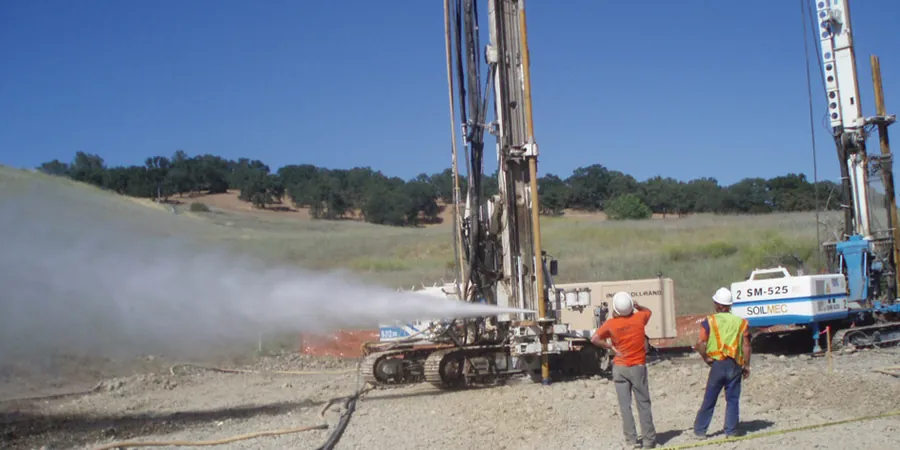
Illustrative image of Jet grouting design in Melbourne
In Melbourne's variable ground, jet grouting design must account for buried creek lines and reclaimed swamps before the first hole is drilled.

Our service areas

Methodology and scope

Melbourne's rapid expansion since the 1850s gold rush has left a legacy of reclaimed swamps, former creek lines, and variable fill depths that directly affect how we plan jet grouting design today. The Yarra River corridor, for instance, hides buried channels where silt layers alternate with sand lenses in unpredictable patterns. To handle this complexity, our jet grouting design follows AS 1726:2017 for site classification and uses the single-fluid method for cohesive soils and the double-fluid system where permeability exceeds 10⁻⁵ m/s. We integrate data from a MASW survey to map Vs30 profiles across the site, which helps us calibrate grout pressures and rod withdrawal rates before mobilising the rig. The result is a treatment that matches the actual ground conditions rather than a textbook recipe.
Technical reference — Melbourne

Local considerations

One thing we see repeatedly in Melbourne is unexpected obstructions — old timber piles from the wharf era, buried basalt boulders from quarry fill, or abandoned service trenches that weren't on any plan. If the jet grouting design doesn't account for these, the rod can deflect, columns can become eccentric, and treatment zones can be missed entirely. Another common issue is hydrofracture in the soft Coode Island Silt, where high injection pressures blow out the ground surface instead of forming a proper column. Mitigating this requires step-rate injection tests before production and real-time monitoring of return flow rates throughout the operation.

Need a geotechnical assessment?

Reply within 24h.

Email: contact@geotechnicalengineering1.vip

Applicable standards

AS 1726:2017 Geotechnical site investigations, AS 4678:2002 Earth retaining structures (where jet grouting forms part of the wall), AS/NZS 1170.0:2002 Structural design actions – general principles, EN 12716:2018 Execution of special geotechnical works – jet grouting

Technical parameters

ParameterTypical value
Column diameter range0.6 m – 3.5 m depending on soil type and method
Unconfined compressive strength (UCS) target1.0 – 8.0 MPa at 28 days
Permeability after treatment< 1 × 10⁻⁷ m/s for water cutoff work
Grout pressure (single-fluid)300 – 600 bar
Rod withdrawal rate5 – 25 cm/s, adjusted per lift
Water/cement ratio range0.8:1 to 1.2:1 by weight
Quality control testingCoring + UCS per 30 columns (AS 1012.9)

Frequently asked questions

What makes jet grouting design different for Melbourne's Coode Island Silt?

Coode Island Silt is a soft, sensitive estuarine clay with low undrained shear strength — typically 15 to 40 kPa — and high moisture content. Standard jet grouting parameters can hydrofracture this material, so we reduce injection pressure to 250–350 bar, slow the rod withdrawal rate to under 10 cm/s, and use a lower water/cement ratio to limit bleed water that could weaken the column.

How much does jet grouting design typically cost in Melbourne?

For a typical commercial project in Melbourne, jet grouting design and supervision fees range between AU$2,410 and AU$8,620, depending on site complexity, number of trial columns, and the extent of laboratory testing required. Larger projects with multiple treatment zones fall at the higher end.

Which Australian standards apply to jet grouting design?

The primary standard is AS 1726:2017 for geotechnical site investigations. For structural applications where the treated ground forms part of a retaining wall, AS 4678:2002 applies. We also reference EN 12716:2018 as a procedural guide for execution, since Australia does not have a dedicated jet grouting standard.

Can jet grouting design be used for underpinning existing foundations in Melbourne?

Yes, with careful control. In Melbourne's inner suburbs, we often design jet grouting columns beneath existing footings to transfer loads to deeper bearing strata. The key constraint is access: the rig must fit within a 2.5 m headroom if working under a suspended slab, and we use directional drilling if the target zone is offset from the access point.

What verification testing is required after jet grouting treatment?

We follow a risk-based sampling plan: typically one core per 30 columns for UCS testing, plus coring at selected overlap zones to confirm continuity. If the design includes a water cutoff requirement, we run in-situ packer permeability tests in the treated mass. All results are compared against the design targets specified in the project's geotechnical baseline report.

Location and service area

We serve projects across Melbourne.

Location and service area