Geotechnicalengineering1
MELBOURNE
HomeGeophysicsMASW / VS30 (velocidad de ondas de corte)

MASW / VS30 in Melbourne – Shear Wave Velocity Testing

Technical studies that support your project.

LEARN MORE

We run our MASW surveys in Melbourne using a 24-channel seismograph with 4.5 Hz geophones spaced at 2 m intervals along a 48 m spread. A sledgehammer source generates surface waves that we invert to produce a 1D shear wave velocity profile down to 30 m. This gives us the VS30 value directly — no borehole needed. The whole setup fits in a ute, which matters when you're working across Melbourne's varied terrain, from the flat basalt plains of the west to the stiffer sedimentary formations in the east. Before we deploy the array we always check for buried services and surface obstructions. The data acquisition takes about two hours per line, and we process the dispersion curves in the field using SeisImager software. For projects that also require direct strength data we can combine the MASW line with a standard penetration test at a target depth to cross-validate the shear wave results.
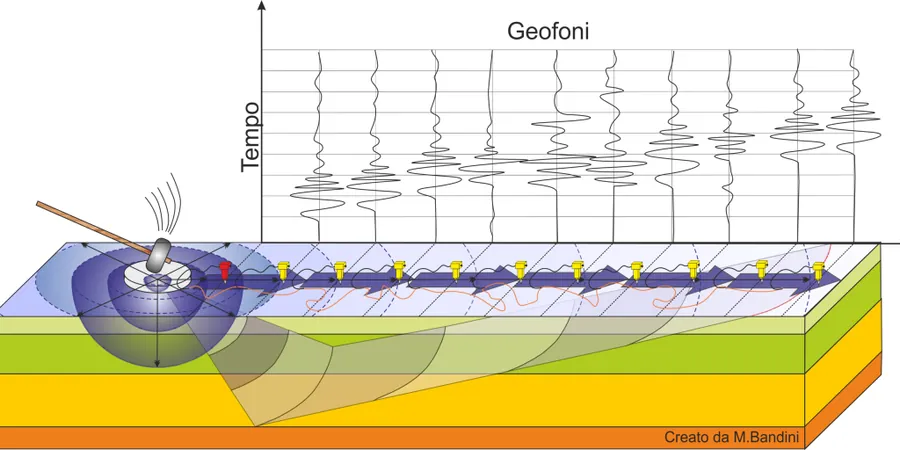
Illustrative image of MASW / VS30 (shear wave velocity) in Melbourne
A MASW survey gives you the VS30 profile in a single afternoon — no borehole, no spoils, no access restrictions.
Our service areas

Methodology and scope

Melbourne's urban geology is a mix of Quaternary alluvium along the Yarra River, Silurian mudstones in the eastern suburbs, and Newer Volcanic basalts covering much of the north and west. The city's growth since the 1850s gold rush created a patchwork of filled land, particularly around Docklands and Southbank. That historical fill can mask the natural soil profile. A MASW survey cuts through that uncertainty because the shear wave velocity profile reflects the actual stiffness of the material below the fill, not just the blow counts. We typically run the survey along two orthogonal lines to capture lateral variability. When we encounter the basalt layer, which can start at depths of 2 to 8 m depending on the suburb, the velocity jump from around 300 m/s to over 700 m/s is very clear on the dispersion curve. That contrast is exactly what we need for accurate site class assignment under AS 1170.4.
Technical reference — Melbourne

Local considerations

The mistake we see most often in Melbourne is treating a single borehole SPT as enough for seismic site classification. A borehole gives you N-values at discrete depths, but it can miss a stiffer layer between blows or a soft lens that controls the average shear wave velocity. We've had cases where the SPT said Class D (soft soil) but the MASW survey across the same footprint showed a Class C (shallow stiff soil) because there was a basalt layer at 6 m that the borehole barely sampled. That reclassification saved the client about $120,000 in unnecessary deep foundation costs. The risk of under-estimating the site stiffness is real, especially in the inner suburbs where historical fill is common. Without a continuous velocity profile you're guessing at the stratigraphy between boreholes.

Need a geotechnical assessment?

Reply within 24h.

Email: contact@geotechnicalengineering1.vip

Applicable standards

AS 1170.4:2007 – Earthquake actions (site class assignment), AS 1289/D4428M-14 – Crosshole seismic testing, NEHRP Recommended Seismic Provisions (FEMA P-1050) – VS30 classification, AS 1726:2017 – Geotechnical site investigations

Technical parameters

ParameterTypical value
Array length48 m (24 channels, 2 m spacing)
Source8 kg sledgehammer on steel plate
Frequency range5 Hz to 70 Hz
Depth of investigation30 m (VS30)
Processing standardAS 1289 / MASW inversion after Park et al. 1999
Field time per lineApprox. 2 hours
Report includes1D Vs profile, dispersion curve, site class per AS 1170.4

Frequently asked questions

What is the difference between VS30 from MASW and site class from AS 1170.4?

VS30 is the average shear wave velocity of the top 30 m of the soil profile. AS 1170.4 uses VS30 to assign a Site Class (Ae, Be, Ce, De, Ee). The class determines the seismic design spectrum for the structure. A MASW survey gives you the continuous Vs profile needed to calculate that average accurately, unlike borehole-based methods that only sample discrete depths.

Can MASW be used on filled ground in Melbourne?

Yes, and it is often the preferred method. Historical fill in areas like Docklands and Fishermans Bend can be highly variable. The MASW surface wave method sees through the fill because the low-velocity surface layer (typically 150–250 m/s) creates a clear dispersion curve that inverts to a real Vs profile. We have successfully surveyed sites with up to 8 m of uncontrolled fill and still obtained reliable VS30 values.

How much does a MASW / VS30 survey cost in Melbourne?

A single-line MASW survey typically ranges between AU$2,660 and AU$4,380 including field work, processing, and a summary report. A two-line orthogonal survey is around AU$3,950 to AU$5,430. The integrated MASW + SPT package costs more due to the borehole component. These are indicative ranges; exact pricing depends on site access, number of lines, and reporting detail.

Do you need a borehole to validate the MASW results?

Not always. The MASW inversion is solid when the dispersion curve is high-quality (low noise, clear fundamental mode). We have run hundreds of lines in Melbourne without a borehole and the results match well with published geological maps. That said, for projects requiring detailed geotechnical design (e.g., high-rise or infrastructure), we recommend adding one SPT borehole at the center of the array for cross-validation. The combination gives you both continuous velocity and discrete strength data.

Location and service area

We serve projects across Melbourne.

Location and service area