Geotechnicalengineering1
MELBOURNE
HomeIn-Situ TestingEnsayo Dilatómetro (DMT)

Flat Dilatometer Test (DMT) in Melbourne – Geotechnical Profiling for Urban & Coastal Sites

Technical studies that support your project.

LEARN MORE

Melbourne's geology is a geotechnical mosaic — from the stiff Yarra River clay terraces to the loose Quaternary sands of the Port Phillip coastline. The Flat Dilatometer Test (DMT) shines precisely in these conditions because it captures lateral stress and deformation modulus at every 20 cm depth increment, something a standard SPT log alone cannot do. We have deployed the DMT across over 60 sites in Melbourne, from Southbank high-rises to Cranbourne residential subdivisions, and the pattern is consistent: the city's variable alluvium demands a test that reads both strength and stiffness in the same push. Before mobilising the blade, we often pair the DMT with a resistivity survey to map stratigraphic boundaries, ensuring we target the critical layers. The blade itself is a stainless steel wedge with an expandable membrane — it measures the pressure needed to lift the membrane (p0), then the pressure at 1.1 mm expansion (p1). From those two numbers we derive the material index (Id), horizontal stress index (Kd), and dilatometer modulus (Ed). For Melbourne's deeply weathered Silurian mudstone profiles, the DMT's ability to detect overconsolidation ratios above 4 is particularly valuable — it tells us whether the ground has been preloaded by past glaciation or simply deposited under normal conditions.
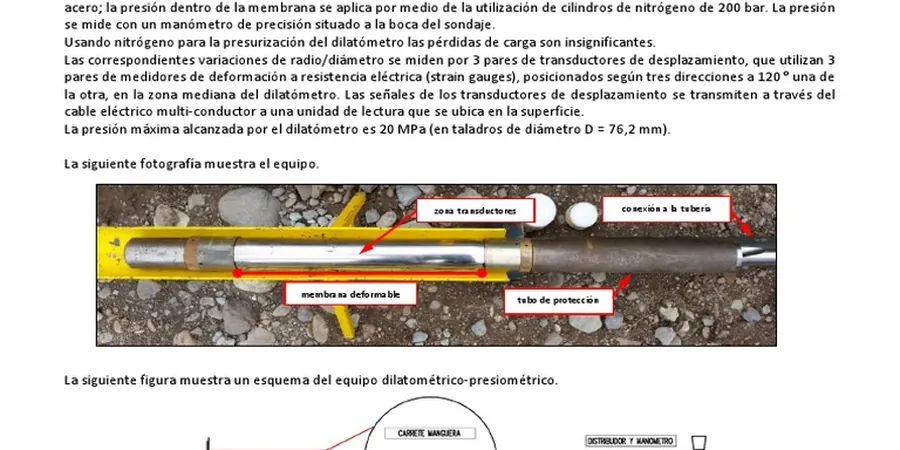
Illustrative image of Flat Dilatometer Test (DMT) in Melbourne
The DMT gives us both stiffness and stress history in one push — for Melbourne's variable alluvium, it halves the uncertainty in settlement predictions.
Our service areas

Methodology and scope

Melbourne sits at an average elevation of just 31 metres above sea level, with the Yarra River floodplain creating soft, compressible clays that can reach 25 metres in thickness. In these low-lying corridors, the Flat Dilatometer Test provides the constrained modulus (M) needed for settlement analysis under medium-rise structures. We have calibrated our DMT correlations against local oedometer tests and found that the Marchetti (1980) formulation for M overpredicts by about 12% in Melbourne's highly plastic basal clays, so we apply a site-specific correction factor of 0.88. The test procedure is standard: we push the blade at 20 mm/s using a CPT truck or a drilling rig, pausing every 20 cm to perform the membrane expansion. Each reading takes about 30 seconds, so a 30-metre profile is completed in under an hour. The raw data goes straight to our in-house software, which applies the Australian-standard correction for membrane stiffness (ΔA = 0.05–0.10 bar, depending on membrane age). In Melbourne's eastern suburbs where residual soils from the Silurian sandstone are common, we integrate DMT results with cimentations superficielles design charts to refine allowable bearing pressures. The test also delivers a reliable estimate of the coefficient of consolidation (ch) when the membrane is held in the expanded position — useful for predicting long-term settlement rates under Melbourne's seasonal rainfall cycles.
Technical reference — Melbourne

Local considerations

The DMT blade is a 95 mm wide, 15 mm thick steel wedge that weighs about 8 kg. It is pushed into the ground using a hydraulic thrust system — typically a CPT truck with 200 kN reaction or a drill rig with a dedicated DMT adapter. In Melbourne's inner suburbs where underground utilities are dense, we run a GPR survey first to avoid hitting gas mains or telecom conduits. The blade's membrane is inflated with nitrogen from a control box at surface; if the ground contains sharp gravel or anthropogenic fill, the membrane can rupture mid-test. That happened once on a site in Footscray where demolition rubble had been buried — we now pre-drill through suspected fill to a clean depth of 2 metres before starting the DMT profile. The test generates no soil cuttings, which is an advantage on Melbourne's contaminated brownfield sites (e.g., gasworks in Fitzroy), but it does leave a 15 mm blade cavity that needs to be grouted after extraction to prevent preferential seepage paths.

Need a geotechnical assessment?

Reply within 24h.

Email: contact@geotechnicalengineering1.vip

Applicable standards

AS 1289.6.5.2 (Standard Test Method for Performing the Flat Plate Dilatometer), AS 1726:2017 (Geotechnical Site Investigations – Appendix F for DMT interpretation), Eurocode 7 (EN 1997-2:2007) – Section 6.5 for in-situ test correlations

Technical parameters

ParameterTypical value
Constrained Modulus (M)3–80 MPa depending on soil type and OCR
Horizontal Stress Index (Kd)1.5–8.0; values above 4 indicate overconsolidation
Material Index (Id)0.1–3.5; distinguishes clay, silt, sand
Coefficient of Consolidation (ch)10⁻⁷ to 10⁻⁵ m²/s from membrane expansion hold
Shear modulus (G)5–50 MPa derived from Ed and Poisson's ratio

Frequently asked questions

What is the difference between DMT and CPT in Melbourne soils?

CPT measures cone resistance and sleeve friction continuously, giving a strength profile. DMT adds lateral stress (Kd) and constrained modulus (M) at 20 cm intervals. In Melbourne's overconsolidated clays, DMT provides more accurate settlement predictions because it directly measures stiffness, while CPT-derived stiffness requires empirical correlations that can be off by 30-50% in the Yarra River clays.

In which Melbourne suburbs is DMT most recommended?

DMT is especially valuable in the Yarra River floodplain (Richmond, South Yarra, Cremorne), where soft alluvial clays up to 25 m thick require accurate modulus for settlement control. It is also effective in the eastern suburbs (Box Hill, Doncaster) where residual soils from Silurian sandstone need both strength and stiffness data. We typically recommend DMT over CPT when OCR is expected above 3 or when lateral earth pressure is critical for basement wall design.

How long does a DMT profile take in the field?

A standard 30 m DMT profile takes 45 to 60 minutes of push time, plus 30 minutes for setup and grouting. The membrane expansion at each depth takes about 30 seconds, and we do 150 readings total (every 20 cm). The total field time including mobilisation is typically 2 to 3 hours per hole. Seismic DMT adds another 30 minutes for the shear wave measurements.

What is the typical cost range for a DMT investigation in Melbourne?

The typical cost for a standard DMT profile (30 m, 20 cm intervals) in Melbourne ranges from AU$1,450 to AU$1,850, inclusive of field testing, data processing, and a summary report. Seismic DMT adds approximately AU$300–AU$500 per hole. Costs vary with site access, depth, and number of holes, but the DMT is generally more cost-effective than continuous undisturbed sampling for settlement design.

Location and service area

We serve projects across Melbourne.

Location and service area